
Are you really connecting with your customers, or just meeting their basic needs? In today’s world, knowing your customers is more than just knowing what they like. It’s about understanding their consciousness levels to build a deeper bond.
Customer experience is key to staying ahead, research shows. By knowing the 9 levels of customer consciousness, businesses can craft a holistic marketing strategy that speaks to their audience on many levels. This strategy helps companies use customer engagement techniques better, boosting their digital marketing success.
Studies reveal that focusing on customers can greatly improve satisfaction and loyalty. For example, research on customer-centric service frameworks stresses the need to understand customer needs at different levels. A holistic framework for customer-centric service helps businesses make meaningful connections with their customers. Also, applying Zen philosophy’s nine levels of consciousness to the customer journey offers a fresh view on holistic customer engagement.
Key Takeaways
- Understanding the 9 levels of customer consciousness is key for a holistic marketing approach.
- Customer experience is a big advantage in the market.
- A customer-centric strategy boosts satisfaction and loyalty.
- Good customer engagement techniques are essential for connecting with your audience.
- Digital marketing can be improved by knowing customer consciousness levels.
Understanding Customer Consciousness in Modern Marketing
In today’s digital world, knowing what customers think about brands is key. Customer consciousness is about what people know and feel about products and services. As people get better at using digital tools, their views on brands change a lot.

The Evolution of Customer Awareness in the Digital Age
The digital age has changed how we talk to businesses. It’s important to know how customer awareness has grown. Research shows that customers go through many steps when they interact with a brand (Lemon & Verhoef, 2016). This means we need a complete marketing plan that includes SEO optimization, branding tactics, and content strategy.
Now, customers can find lots of information easily. This makes them pickier and want more personal experiences with brands.
Why Traditional Marketing Approaches Fall Short Today
Old marketing ways don’t work well anymore. They don’t handle the new ways customers interact with brands. Experts say, “the old rules of marketing no longer apply” (zen9marketing). Businesses need to be more careful and listen to customers to do well.
Here are some important parts of this new marketing:
- Personalized content that speaks to customers
- Strategies that let customers interact with brands
- Ways to get feedback and change based on what customers say
By using these, businesses can make marketing that really works today.
The 9 Levels of Customer Consciousness Framework
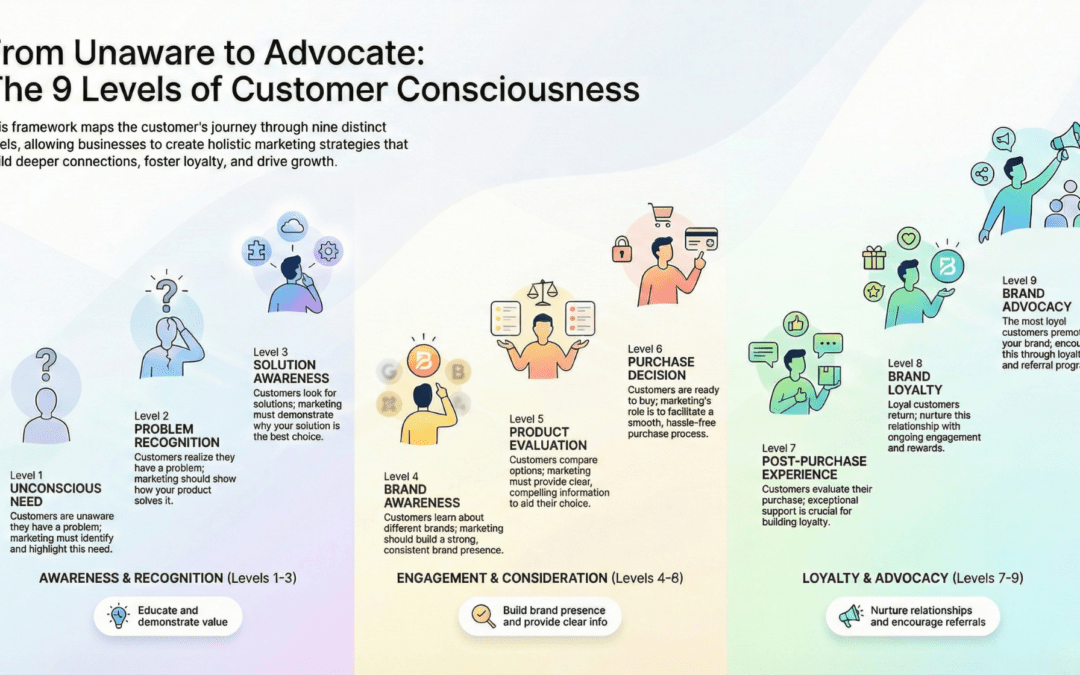
The 9 Levels of Customer Consciousness Framework helps businesses understand what customers need and want. By addressing these levels, companies can create marketing that really speaks to their audience.
Levels 1-3: Basic Awareness and Recognition
The first steps in customer consciousness are about basic awareness and recognizing a need or problem. This is key for businesses to tailor their marketing well.
Level 1: Unconscious Need
At this level, customers don’t know they have a need or problem. Businesses need to find out these unconscious needs through deep market research.
Level 2: Problem Recognition
Customers start to see their problems and look for solutions. Companies should show how their products or services solve these problems, making their value clear.
Level 3: Solution Awareness
Customers know solutions exist and are looking for the best one. Businesses must show why their offerings are the best through good marketing and communication.
Levels 4-6: Engagement and Consideration
As customers move forward, they engage more with brands and think about their options. This stage is key for businesses to connect deeply with their audience.
Level 4: Brand Awareness
Customers start to know about different brands and what they offer. Companies should focus on building strong brand awareness through consistent messages and engagement.
Level 5: Product Evaluation
Customers now compare different products or services. Businesses must give clear, compelling information to help customers make good choices.
Level 6: Purchase Decision
Customers are ready to buy. Companies should make the buying process easy, so customers can buy without hassle.
Levels 7-9: Loyalty and Advocacy
The last stages are about building loyalty and getting customers to advocate for the brand. Businesses that succeed here build lasting relationships with their customers.
Level 7: Post-Purchase Experience
After buying, customers judge their experience. Companies must give great support after the purchase to keep customers loyal.
Level 8: Brand Loyalty
Loyal customers keep coming back to the same brand. Businesses should keep this loyalty alive with ongoing engagement and rewards.
Level 9: Brand Advocacy
The most loyal customers become brand advocates, recommending the brand to others. Companies can encourage advocacy through good email marketing and loyalty programs.

| Level | Description | Marketing Strategy |
|---|---|---|
| 1 | Unconscious Need | Identify and highlight the need |
| 2 | Problem Recognition | Show how your product/service solves the problem |
| 3 | Solution Awareness | Demonstrate the superiority of your solution |
| 4 | Brand Awareness | Build strong brand presence |
| 5 | Product Evaluation | Provide clear, compelling product information |
| 6 | Purchase Decision | Facilitate a smooth purchasing process |
| 7 | Post-Purchase Experience | Deliver exceptional post-purchase support |
| 8 | Brand Loyalty | Nurture loyalty through engagement and rewards |
| 9 | Brand Advocacy | Encourage advocacy through loyalty programs and email marketing |
Building a Holistic Marketing Strategy for Consciousness Levels
To connect with customers, businesses need a holistic marketing strategy. This strategy understands customer consciousness and creates content and engagement plans (Jaakkola et al., 2022). It helps companies guide customers from awareness to loyalty and advocacy.
Content Strategies for Early Consciousness Levels
For early consciousness levels (Levels 1-3), focus on awareness and value. Use blog posts, social media, and educational resources to address pain points. For example, a company might create guide articles or infographics to solve common problems.
By using content marketing strategies, businesses can attract and engage with customers.
| Content Type | Objective | Target Consciousness Level |
|---|---|---|
| Blog Posts | Awareness, Education | Levels 1-2 |
| Social Media Content | Engagement, Awareness | Levels 2-3 |
| Educational Resources | Education, Trust Building | Levels 2-3 |
Digital Engagement Tactics for Middle Consciousness Levels
At middle consciousness levels (Levels 4-6), customers engage more deeply. Digital engagement tactics are key. Use email marketing, personalized content, and interactive experiences to keep interest high.
For example, a business might use email nurturing campaigns to support customers in the consideration phase.
Relationship Building Techniques for Advanced Consciousness Levels
At advanced levels (Levels 7-9), focus on loyalty and advocacy. Use personalized customer service, loyalty programs, and user-generated content campaigns to strengthen relationships. Engage personally and recognize loyalty to turn customers into advocates.
Implementing Your Holistic Marketing Strategy Across Channels
To make a holistic marketing strategy work, businesses need to use many channels. This helps reach customers at different levels of awareness. It’s key for a smooth customer experience and better marketing results.

Integrating SEO and Content Strategy with Consciousness Levels
Combining SEO and content strategy is essential. It helps attract customers at various awareness levels. By optimizing content for search engines, businesses can get more online visibility. This draws in people looking for specific info.
For the early stages, create content that answers basic questions. As customers move up, the content should get more detailed and personal.
For example, using local SEO strategies targets customers in specific areas. This makes the experience more personal, matching the customer’s growing awareness.
Aligning Social Media and Customer Engagement with Consciousness Stages
Social media is key for engaging customers at different awareness levels. By tailoring social media content to what customers want, businesses can build strong connections. For early stages, social media helps raise awareness and share basic info.
As customers get more involved, social media can help build lasting relationships and loyalty.
Good online presence management means watching how customers interact on social media. This helps adjust the marketing strategy for a unified brand image. It supports a holistic marketing approach.
Conclusion: Transforming Your Business Through Conscious Marketing
Understanding customer consciousness is key for a good Holistic Marketing Strategy. Knowing how aware your customers are lets you tailor your marketing. This way, you meet their specific needs.
A solid Holistic Marketing Strategy starts with a deep Target audience analysis. This lets you create content that speaks directly to your customers. It builds strong connections, leading to lasting customer relationships and business growth.
Studies show that conscious marketing leads to success. For example, 81% of people think companies should help the environment. This shows the value of adding sustainability to your marketing plans (source). Also, using data helps businesses understand the market and predict what customers will want next (source).
By adopting a Holistic Marketing Strategy and listening to your audience, you can change your marketing. This leads to lasting growth for your business.